11259. Minimum triangulation
You are given a regular polygon
with vertices numbered from 1 to n in counterclockwise order.
Triangulation of this polygon is a
decomposition into triangles such that:
·
each
vertex of any triangle is a vertex of the original polygon;
·
no two
triangles have a positive-area intersection;
·
the
union of all triangles exactly covers the area of the original polygon.
The weight of a triangulation is defined as
the sum of the weights of its triangles, where the weight of a triangle is the
product of the labels of its vertices.
Find the minimum weight among all possible
triangulations of the given polygon.
Input. One
integer n (3 ≤ n ≤ 500)
– the number of vertices of
the polygon.
Output. Print
the minimum weight among all triangulations of the given polygon.
|
Sample
input 1 |
Sample
output 1 |
|
3 |
6 |
|
|
|
|
Sample
input 2 |
Sample
output 2 |
|
4 |
18 |
SOLUTION
combinatorics
Algorithm analysis
Consider a triangle that
contains the side (1, n). Let its third vertex be x, then the
triangle has the form (1, n, x).
If x = n – 1, we simply remove the
triangle (1, n, n – 1), after which an (n – 1) - gon remains, which we
triangulate further.
If 1 < x < n – 1, consider the triangle (n, x, k),
where x < k < n.
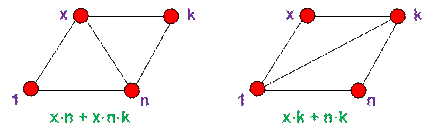
Replace the pair of
triangles (1, x, n) and (n, x, k) with the pair (1, x, k) and (1, n, k). The total weight of the
triangles decreases, since xn + xnk > xk + nk. After regrouping, we
obtain
x(n – k) + nk(x – 1) > 0
The inequality holds
because n – k > 0 and x – 1 > 0.
It follows that it is
preferable to replace the triangle (1, x, n) with (1, k, n), where k > x. Therefore, the
optimal choice is x = n – 1. The minimum weight
triangulation is obtained by drawing all diagonals from vertex 1.
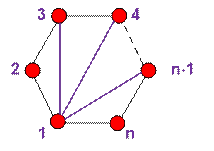
The sum of the weights of
all triangles incident to vertex 1 is equal to
1 * 2 * 3 + 1 * 3 * 4 + … + 1 * (n – 1) * n = 
Example
In the first test, the
polygon is a triangle with vertices 1, 2, 3. Its weight is 1 * 2 * 3 = 6.
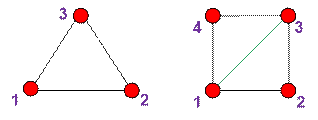
In the second test, the
polygon is a square with vertices 1, 2, 3, 4. The minimum weight is achieved by the
triangulation with the diagonal (1, 3):
1 * 2 * 3 + 1 *
3 * 4 = 6 + 12 = 18
Algorithm implementation
Read
the input data.
scanf("%d", &n);
Compute
the answer.
res = 0;
for (i = 2; i < n; i++)
res += 1ll * i * (i + 1);
Print
the answer.
printf("%lld\n", res);