11554. Catch the plane
Your plane to the ICPC World Finals departs
soon, and the only way to reach the airport is by bus. Unfortunately, some
drivers are considering going on strike, so you are not sure whether you will
arrive on time. Your goal is to plan the trip in such a way as to maximize the
probability of catching your flight.
You are given a detailed map of the city
showing all bus stations. You are currently at station 0, and the airport is located at station 1. You have the complete schedule: for each bus you
know the departure time from its starting station and the arrival time at its
destination. Moreover, for every bus you are given the probability that it will
actually operate and that its driver will not go on strike. Assume that all
these events are independent. In other words, the probability that a particular
bus runs according to the schedule does not depend on whether any other bus is
running.
If you arrive at a station strictly before
a bus departs, you may try to board it. However, if you arrive exactly at the
departure time, you will not have enough time to get on the bus. It is
impossible to know in advance whether a bus will operate as scheduled – you will only find out at the moment you attempt to
board it. If several buses depart from the station at the same time, you may
try to board only one of them.
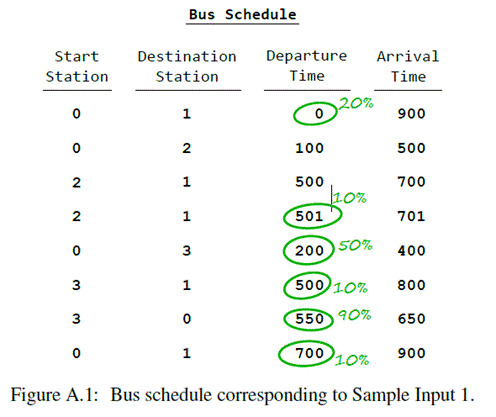
Consider the schedule shown in the figure.
It lists the departure and arrival stations for several routes, as well as
their departure and arrival times. Next to some of the routes, the probability
that the bus will actually operate is given. For routes where the probability
is not specified, it is assumed to be 100%.
You may try to take the earliest bus. If it
runs, it will take you directly to the airport, and there is nothing to worry
about. Otherwise, the situation becomes more complicated. You can take the
second bus to station 2. It will certainly depart, but then you will miss the
third bus in the list, which would have brought you to
the airport in time. The fourth bus you can still
catch has a probability of only 0.1 of operating. This is too risky, so it is
better to stay at station 0 and wait for the fifth bus.
If you manage to board it, you can then try to transfer to the sixth bus to the
airport; if it does not run, you will still have a chance to return to station
0 and catch the last bus going directly to the airport.
Input. The first line contains two integers m (1 ≤ m ≤ 106)
and n (2 ≤ n ≤ 106) – the number of bus routes and the number
of stations in the city. The next line contains one integer k (1 ≤ k ≤ 1018) – the time by which you must arrive at the
airport.
Each of the following m lines
describes one route. Each line contains integers a and b (0 ≤ a, b <
n, a ≠ b) – the starting and ending stations. Then follow integers s and t (0 ≤ s < t
≤ k) – the
departure time from station a and the arrival time at station b.
The last value in the line is a number p (0 ≤ p ≤ 1, with at most 10 digits after the decimal point), denoting the
probability that the bus will operate according to the schedule.
Output. Print the probability that you will catch your plane
if you act optimally. Your answer must have an absolute or relative error of at
most 10-6.
|
Sample
input 1 |
Sample
output 1 |
|
8 4 1000 0 1 0 900 0.2 0 2 100 500 1.0 2 1 500 700 1.0 2 1 501 701 0.1 0 3 200 400 0.5 3 1 500 800 0.1 3 0 550 650 0.9 0 1 700 900 0.1 |
0.3124 |
|
|
|
|
Sample
input 2 |
Sample
output 2 |
|
4 2 2 0 1 0 1 0.5 0 1 0 1 0.5 0 1 1 2 0.4 0 1 1 2 0.2 |
0.7 |
SOLUTION
probability
Algorithm analysis
To solve the problem, we
use a dynamic programming approach where routes are considered in decreasing
order of departure time.
Let’s consider the
following state:
·
The passenger is at station x at time time.
What is the maximum
probability of reaching the airport on time from x under an optimal
strategy? We denote this quantity as best(x, time). The parameter
time can take values up to 1018, so the number of states is effectively infinite. If
we are standing at a station waiting, the situation only changes at moments
when a bus departs. Therefore, we’ll consider only bus departure times.
When we compute best(B, S) for a given route, transitions are possible
only to states with later times:
·
If the
bus runs, we move to the point (E, T),
·
If the
bus does not run, we stay at (B, S) and wait for the
next route.
In both cases, the next moment in time is
strictly later than the current one. Thus, if we process the routes in
decreasing order of departure time, all the necessary future values will
already have been computed.
Dynamic Programming Transitions
Consider the following route:
·
B → E, departure S, arrival T, probability
of running p
Then there are two
possible actions:
1. We try to take the bus. If
the bus runs, the probability of this event is p. In this case, we move to the state (E, T) and then continue
acting optimally:
p * best(E, next route > T)
If you arrive exactly at the departure
time, there is no time left to board the bus. Therefore, we look for the next
departure from station E that is strictly greater than T.
If the bus is canceled,
the probability of this event is 1 – p. In this case, we remain at station B and wait for the next
route:
(1 – p) * best(B, next route > S)
If several buses depart from the station at
the same time, you can attempt to board only one of them. If that bus is
canceled, you cannot board another bus from station B at time S. You must wait for a route whose departure time is
strictly greater than S.
2. We do not try to take
the bus at all. In that case, we move to the next bus at the same station:
best(B, next route ≥ S)
Thus, the transition has
the following form:
best(B, S) =
max(p * best(E, next
route > T) + (1 – p) * best(B, next route > S),
best(B, next route ≥ S))
Example
Sort the routes in the
first example by station number and departure time. On the right, list the
pairs (departure time, route number) sorted by departure time.
|
Route number |
Departure station |
Arrival station |
Departure time |
Arrival time |
Probability |
Pair |
|
0 |
0 |
1 |
0 |
900 |
0.2 |
(0, 0) |
|
1 |
0 |
2 |
100 |
500 |
1.0 |
(100, 1) |
|
2 |
0 |
3 |
200 |
400 |
0.5 |
(200, 2) |
|
3 |
0 |
1 |
700 |
900 |
0.1 |
(500, 5) |
|
4 |
1 |
1 |
1001 |
1001 |
1.0 |
(500, 7) |
|
5 |
2 |
1 |
500 |
700 |
1.0 |
(501, 6) |
|
6 |
2 |
1 |
501 |
701 |
0.1 |
(550, 8) |
|
7 |
3 |
1 |
500 |
800 |
0.1 |
(700, 3) |
|
8 |
3 |
0 |
550 |
650 |
0.9 |
(1001, 4) |
Compute the probabilities
of arriving at the airport in decreasing order of bus route departure times.
The notation time+ denotes a time strictly greater than time.
best(1, 1001) = 1.0;
best(0, 700) = 0.1 *
best(1, 900+) = 0.1 * 1 = 0.1;
best(3, 550) = 0.9 *
best(0, 650+) + 0.1 * best(3, 550+) = 0.9 * 0.1 = 0.09;
best(2, 501) = 0.1 *
best(1, 701+) + 0.9 * best(2, 501+) = 0.1 * 1.0 + 0.9 * 0
= 0.1;
best(3, 500) = 0.1 *
best(1, 800+) + 0.9 * best(3, 500+) =
0.1 * 1.0 + 0.9 * 0.09 =
0.181;
best(3, 500) = max(best(3,
500), best(3, 550)) = max(0.181, 0.09) = 0.181;
best(2, 500) = 1.0 *
best(1, 700+) + 0.0 * best(2, 500+) = 1.0;
best(2, 500) = max(best(2,
500), best(2, 501)) = max(1.0, 0.1) = 1.0;
best(0, 200) = 0.5 *
best(3, 400+) + 0.5 * best(0, 200+) =
0.5 * 0.181 + 0.5 * 0.1 =
0.0905 + 0.05 = 0.1405;
best(0, 200) = max(best(0,
200), best(0, 700)) = max(0.1405, 0.1) = 0.1405;
best(0, 100) = 1.0 *
best(2, 500+) + 0.0 * best(0, 100+) = 1.0 * 0.1 = 0.1;
best(0, 100) = max(best(0,
100), best(0, 200)) = max(0.1405, 0.1) = 0.1405;
best(0, 0) = 0.2 * best(1,
900+) + 0.8 * best(0, 0+) =
0.2 * 1.0 + 0.8 * 0.1405 =
0.2 + 0.1124 = 0.3124;
best(0, 0) = max(best(0,
0), best(0, 100)) = max(0.3124, 0.1405) = 0.3124;
Algorithm implementation
Define the structure of a bus route, Route. It contains:
·
B – the starting station (where the bus departs from);
·
E – the destination station (where the bus arrives);
·
S – the departure time from the starting station;
·
T – the arrival time at the destination station;
·
P – the probability that the bus will run on the route;
·
value – the maximum probability of reaching the airport (station 1)
if the journey starts with this bus and the remaining route is chosen optimally.
struct Route
{
int B, E;
long long S, T;
double P, value;
Bus routes are sorted:
·
by departure time S
bool operator<(const Route& r) const
{
return S < r.S;
}
};
The main part of the program. Read the input data.
scanf("%d %d %lld", &m, &n, &k);
Create a list of all routes grouped by departure station. The vector v
has size n, which is the number of stations. Thus,
·
v[i] contains the list of all bus routes departing
from station i.
vector<vector<Route>> v(n);
for (int i = 0; i < m; i++)
{
scanf("%d %d %lld %lld %lf", &r.B, &r.E, &r.S, &r.T, &r.P);
The maximum probability of reaching the airport from this route is
initially unknown, so we initialize it to 0.
r.value = 0.0;
Add route r to the list of routes that start from r.B.
v[r.B].push_back(r);
}
Now we create a dummy route that represents the moment when the passenger
is already at the airport (station 1). Both the starting and ending stations
are the airport.
r.B = 1;
r.E = 1;
The probability that this route succeeds is 100%.
r.value =
1.0;
r.P = 1.0;
The departure time and arrival time are later than all others.
r.S = k +
1;
r.T = k +
1;
Add this dummy route to the list of
routes departing from the airport.
v[1].push_back(r);
For each station i, sort all routes
departing from that station (v[i]) by departure time S. This is necessary to efficiently find the next route later
using upper_bound.
for (int i = 0; i < n; i++)
sort(v[i].begin(), v[i].end());
Create a single processing order for
all routes based on departure time so that the dynamic programming can proceed
from later routes to earlier ones.
Declare a vector of pairs, ord,
which stores for each route:
1.
Departure time S.
2.
Route indices: {i, j}
·
i – station number
·
j – route number in v[i]
Thus, each entry in ord indicates: “Route v[i][j] departs
at time S”.
vector<pair<long long, pair<int, int>>> ord;
for (int i = 0; i < v.size(); i++)
for (int j = 0; j < v[i].size(); j++)
ord.push_back({ v[i][j].S, {i, j} });
Sort the vector ord in
ascending order of departure times for all routes, regardless of the station.
sort(ord.begin(),
ord.end());
The variable ret computes the
maximum probability of catching the flight when starting from station 0 at time
0.
double ret = 0.0;
Iterate through the routes in
decreasing order of departure time, so that for the current route, the value of
all future routes (those departing later) has already been computed, allowing
us to correctly compute the optimal probability.
for (int itOrd = m; itOrd >= 0; itOrd--)
{
Let us store the departure time of
the current route in the variable startTime.
long long startTime = ord[itOrd].first;
p is a pair of indices that allows us to locate the current
route in the array of routes v: the route itself is stored in v[p.first][p.second].
auto p = ord[itOrd].second;
If the departure time startTime
> k (meaning it is impossible to catch the plane), we simply skip
this route.
if (startTime > k) continue;
st is
the index of the departure station for the current route.
int st = p.first;
r is
the current route for which we compute the value.
Route& r = v[p.first][p.second];
Initialize the value for the
current route to zero.
r.value = 0.0;
query is a
temporary object of type Route
that is used to find the next route using upper_bound.
We do not use all its fields – only B and S, which are needed for comparison
during the search.
Route query;
Configure query for the
following scenario: we want to find the first bus from the same station that
departs strictly later than the current time S, if the current bus is canceled
(does not run).
query.B = r.B;
query.S = r.S;
We look for the
first bus from the same station that departs later.
auto it = upper_bound(v[st].begin() + p.second, v[st].end(), query);
if (it != v[st].end())
If such a route exists, increase r.value
by the probability of success through it.
r.value += (1.0 - r.P) * it->value;
Consider the scenario where the bus
actually runs. In this case, at time T we arrive at station E. We prepare the
object query to search for the next route. We formulate the query: “Find
a bus that departs from station E later than time T.”
query.B = r.E;
query.S = r.T;
The variable d stores the
index of station E, where we have arrived.
int d = r.E;
Search for the next bus after
arriving at E in the list of routes v[d] using binary search. Its
departure time from E must be strictly greater than T, because according to the
problem statement, if you arrive exactly at the departure time, you cannot
board the bus.
it = upper_bound(v[d].begin(), v[d].end(), query);
if (it != v[d].end())
If such a route is found, it means we
can transfer to it. Add the contribution of the probability p * best(E, next route > T).
r.value += r.P * it->value;
The next option we consider is to skip
the current bus. That is, we do not even consider the option of boarding it or
not. We wait for the next bus at the same station.
Check if the next bus exists at this
station. Recall that the current route r is stored in v[p.first][p.second].
if (p.second + 1 < v[p.first].size())
If the bus exists and the probability
of successfully reaching the airport using it is higher, we update value.
Here:
·
r.value is the probability of success if we try to board the current bus;
·
v[p.first][p.second
+ 1].value is the probability of success if we
skip the current bus and wait for the next one.
r.value = max(r.value, v[p.first][p.second + 1].value);
Update the overall answer. We select
the best option only among the buses that depart from the initial (zero)
station.
if (r.B == 0) ret =
max(ret, r.value);
}
Print the answer.
printf("%.6lf\n", ret);