12318. Sum in field
For the given integers a, b, c, n, p, compute the value of the sum:
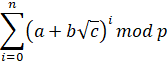
Print the result as two numbers x and
y such that
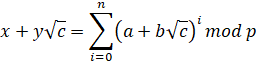
Input. Five integers a, b,
c, n, p. It
is known that:
·
p < 109 is a prime
number,
·
0 ≤ a, b
< p,
·
1
≤ c < p,
·
0 ≤ n ≤
109
Output. Print two integers x and y – the coefficients of 1 and  respectively,
modulo p.
respectively,
modulo p.
|
Sample input 1 |
Sample output
1 |
|
2 1 5 2 17 |
12 5 |
|
|
|
|
Sample input 2 |
Sample output
2 |
|
3 2 5 10 17 |
15 6 |
SOLUTION
combinatorics
Algorithm analysis
All computations should be
performed in the extended field:

Operation rules:
·
Addition

·
Multiplication

Let x =  . Then the required sum is
a finite geometric progression:
. Then the required sum is
a finite geometric progression:
1 + x + x2
+ x3 + … + xn =  =
= 
It remains to perform the division a = xn+1
– 1 by b = x – 1 in the field  :
:
 =
=  =
= 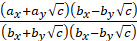 =
= 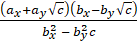 =
=

Example
In the first example
 =
=
(1 + ( ) + (
) + ( )) mod 17 = 12
Let’s compute this example
using the formula:
=  =
=
= 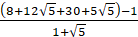 =
=  =
=  =
=
 =
=  =
=  =
= 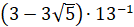 =
=
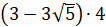 =
=  =
= 
In the second example
 = 15
= 15
Algorithm implementation
The function modpow
computes the value ak mod p.
long long modpow(long long a, long long k, long long p)
{
long long res = 1;
a %= p;
while (k)
{
if (k & 1) res = res * a % p;
a = a * a % p;
k >>= 1;
}
return res;
}
Let’s define a structure Num
to store numbers of the form  .
.
struct Num
{
long long x, y; // x + y*sqrt(c)
};
Let’s implement addition in the field . The function add
returns the sum of two numbers a and b.
Num add(Num& a, Num& b)
{
Num res;
res.x = (a.x + b.x) % p;
res.y = (a.y + b.y) % p;
return res;
}
Let’s implement subtraction in the field . The function sub
returns the difference of two numbers a and b.
Num sub(Num& a, Num& b)
{
Num res;
res.x = (a.x - b.x + p) % p;
res.y = (a.y - b.y + p) % p;
return res;
}
Let’s implement multiplication in the field . The function mult
returns the product of two numbers a and b.
Num mult(Num& a, Num& b)
{
Num res;
res.x = (a.x * b.x + c * a.y % p * b.y) % p;
res.y = (a.x * b.y + a.y * b.x) % p;
return res;
}
The function pow implements exponentiation of basen, where base
is an element of the field .
Num pow(Num base, long long n)
{
Num res = { 1, 0 }; // единица поля
while (n > 0)
{
if (n & 1)
res
= mult(res, base);
base = mult(base, base);
n >>= 1;
}
return res;
}
The function divide implements division in the field . It returns the quotient of
the numbers a and b. The division is performed by multiplying by the conjugate:
= = = =
Num divide(Num& a, Num& b)
{
Let conj =  .
.
Num conj = { b.x, (p - b.y) % p };
Compute n =  .
.
Num n = mult(a, conj);
Compute denom =  .
.
long long denom =
((b.x * b.x) % p - ((b.y * b.y) % p * c) % p + p) % p;
Compute the multiplicative inverse and return n / denom = n
* denom-1.
long long inv_denom = modpow(denom, p - 2, p);
return Num((n.x * inv_denom) % p, (n.y * inv_denom) % p);
}
The main part of the program. Read the input data.
scanf("%lld %lld %lld %lld %lld", &a, &b, &c, &n,
&p);
Initialize the number x = and the multiplicative identity of the field one =  .
.
Num x = { a % p, b % p };
Num one = { 1, 0 };
Compute num = xn+1 – 1, denom = x
– 1.
Num num = pow(x, n + 1);
num = sub(num, one);
Num denom = sub(x, one);
Compute and print the answer res = num / denom =
.
Num res = divide(num, denom);
printf("%lld %lld\n", res.x, res.y);