1317. Birthdays
Рожь. 1878.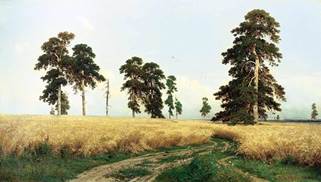 Пейзаж стал классическим и программным
произведением, как для самого художника, так и для художественной критики его
времени. На одном из эскизов к картине И.И. Шишкин сделал запись, которую можно
считать его творческим кредо: «Раздолье, простор, угодье, рожь, Божья
благодать, русское богатство».
Пейзаж стал классическим и программным
произведением, как для самого художника, так и для художественной критики его
времени. На одном из эскизов к картине И.И. Шишкин сделал запись, которую можно
считать его творческим кредо: «Раздолье, простор, угодье, рожь, Божья
благодать, русское богатство».
Лирическое отношение к отечественной
природе, воспетое И.И. Шишкиным, было ярко выражено в стихах Н.А. Некрасова:
Все рожь кругом, как степь живая,
Ни замков, ни морей, ни гор.
Спасибо, сторона родная,
За твой врачующий простор.
It is known that in a group of
23 or more people, the
probability that at least two of them share the same birthday (day and month)
exceeds 50%.
This fact may seem paradoxical, since the probability of a single person being
born on a specific day of the year is very small, and the probability that two
people share a birthday is even smaller. However, the result is confirmed by
probability theory. Therefore, this fact is not a paradox in the strict
scientific sense — there is no logical contradiction. The paradox lies only in
the discrepancy between our intuition and the result of the mathematical
calculation.
Given a number of people, calculate
the probability that at least two of them share the same birthday. Assume that
a year has 365 days.
Input. Each line represents a separate test
and contains the number of people n (1 < n < 400).
Output. For each value of n, print on a
separate line the probability (in percent) that at least two of the n people
share the same birthday (day and month). Print the probability with 8
digits after the decimal
point.
|
Sample input |
Sample output |
|
2 10 23 366 |
0.27397260% 11.69481777% 50.72972343% 100.00000000% |
SOLUTION
probability
Algorithm
analysis
First,
let’s
compute
the probability  that
in a group of n people all birthdays are distinct. If n is
greater than 365, then by the pigeonhole principle this probability is zero. If
n does not exceed 365, we reason as follows.
that
in a group of n people all birthdays are distinct. If n is
greater than 365, then by the pigeonhole principle this probability is zero. If
n does not exceed 365, we reason as follows.
We
choose the first person and note his
birthday. Then we choose the second person: the probability that his birthday does
not coinside
with the first person’s birthday is 1 – 1 / 365. For the third person, the
probability that his
birthday does not coinside
with the birthdays of the first two people is 1 – 2 / 365.
Continuing
this reasoning, for the last person the probability that their birthday does
not coinside
with the birthdays of all the previous ones is 1 – (n – 1) / 365.
Multiplying
all these probabilities, we obtain the probability that all birthdays in the
group are different:

Then,
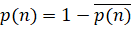
the probability that at least two people out of n share the same
birthday is equal to one minus the probability that all birthdays are distinct:
Algorithm implementation
In the array p[i] we’ll store the corresponding
probability values p(i).
double p[401];
Let p[1] = 1. The remaining values of the
array p[i] are computed using the formula given in the problem analysis.
p[1] = 1.0;
for
(i = 2; i < 401; i++)
p[i] = p[i-1] * (1.0
- (i - 1.0) / 365);
For
each input value n, compute the corresponding probability and print the result.
while
(scanf("%d",&n) == 1)
printf("%.8lf%%\n",(1 - p[n]) * 100);