115. Two digits
How many n-digit
numbers can be formed using only the digits 5 and 9, such that no three identical digits appear
consecutively?
Input.
One integer n (n ≤
30).
Output.
Print the number of
such n-digit
numbers.
|
Sample input |
Sample output |
|
3 |
6 |
SOLUTION
dynamic programming
Algorithm
analysis
We begin
solving the problem by considering the base cases:
·
for n = 1, there are only two valid numbers: 5 and 9.
·
for n = 2, there are
only four valid numbers: 55, 59, 95 and 99.
Let f(n)
denote the number of valid n- digit
numbers. Then:
·
f(1) = 2;
·
f(2) = 4;
Next, we
construct n-digit
numbers based on already constructed numbers of smaller length.
·
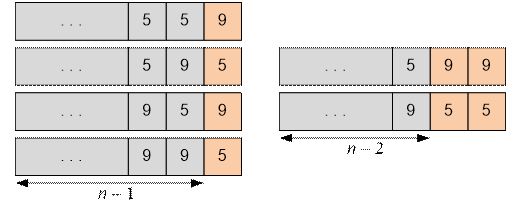
Adding one digit. Take all previously
constructed (n – 1)- digit
numbers and append to each of them a digit different from its last digit. In
this way, we obtain n- digit
numbers ending with 559, 595, 959 and 995. The
total number of such numbers is f(n
– 1).
·
Adding two identical digits. We also
include among the n-digit numbers those that can be obtained from (n – 2)- digit numbers by appending
two fives or two nines, ensuring that no three identical digits appear
consecutively at the end. That is, we also obtain numbers ending with 599 and
955. Thus, we get an additional f(n − 2) valid numbers.
Therefore,
we obtain the following recurrence relation:
f(n) = f(n – 1) + f(n – 2),
f(1) = 2, f(2) = 4
Example
There are
four valid two-digit numbers: 55, 59, 95 and 99.
There are
six valid three-digit numbers: 559, 595, 959, 995, 599 and 955. They are obtained:
·
from two-digit numbers: 55 → 559, 59 → 595, 95 → 959, 99 → 995
·
from one-digit numbers: 5 → 599, 9 → 955
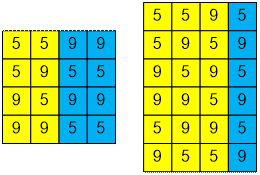
All valid
four-digit numbers are obtained:
·
from three-digit numbers by appending a digit different
from the last one: 5595, 5959, 9595, 9959, 5995 and 9559.
·
from two-digit numbers by appending 55 or 99 in such a way that three identical digits do not
appear consecutively: 5599, 5955, 9599 and 9955.
Algorithm implementation
We’ll store the values f(i)
in the array elements m[i].
int m[31];
Read the input value n.
scanf("%d", &n);
Set the initial values: f(1) = 2 and f(2) = 4.
m[1] = 2; m[2] = 4;
Compute the values m[i] (3 ≤ i ≤ n)
using the recurrence relation.
for(i = 3; i <= n; i++)
m[i] = m[i-1] +
m[i-2];
Print
the result – the
value m[n].
printf("%d\n",m[n]);
Java implementation
import java.util.*;
public class Main
{
public
static int MAX = 32;
static int m[] = new int[MAX];
public static void main(String[] args)
{
Scanner con = new Scanner(System.in);
int n = con.nextInt();
m[1] = 2; m[2] = 4;
for(int i = 3; i <= n; i++) m[i] = m[i-1] + m[i-2];
System.out.println(m[n]);
}
}
Python implementation
Read the input value n.
n = int(input())
Initialize the list m.
m = [0] * 31
Set the initial values: f(1) = 2 and f(2) = 4.
m[1] = 2
m[2] = 4
Compute the values m[i] (3 ≤ i ≤ n)
using the recurrence relation.
for i in range(3, n + 1):
m[i] = m[i - 1] + m[i - 2]
Print
the result – the
value m[n].
print(m[n])