2299. Theodore
Roosevelt
“Theodore Roosevelt” – the flagship of the Kukuland fleet. The sworn enemies of Kukuland,
the Flat-Earthers, decided to destroy it. They learned that “Theodore Roosevelt”
is represented by a convex polygon with vertices, and the
coordinates of all its vertices are known to them. Then they
launched ballistic missiles and recorded the coordinates of their
explosion points. According to the calculations of the Flat-Earthers'
headquarters, “Theodore Roosevelt” will be destroyed if at least k missiles
hit it. Determine whether the Flat-Earthers managed to destroy the ship.
Input. The first line contains integers n, m and k (3 ≤
n ≤ 105, 0 ≤ k ≤ m ≤ 105). The next n lines contain the coordinates of the polygon vertices
in counterclockwise order. The following m lines contain the coordinates of the
explosion points. All coordinates are integers with absolute values not
exceeding 109.
Output. Print “YES” if at least k points lie inside the polygon, and “NO” otherwise.
|
Sample input |
Sample output |
|
5 4 2 1 -1 1 2 0 4 -1 2 -1 -1 -2 -1 1 -1 0 1 2 3 |
YES |
SOLUTION
geometry + binary search
Algorithm analysis
Consider the problem of determining whether
a point belongs to a convex polygon.
Suppose the vertices of the polygon are
given in counterclockwise order: p1, p2, …, pn. Fix the vertex p1. Then all other vertices are ordered around it by polar
angle.
Draw rays from point p1 through the remaining vertices (i.e., the diagonals of
the polygon). We can now apply binary search to find an edge pipi+1 such that the
orientations of the triples of points p1piq and p1pi+1q are different.
Thus, we determine the sector (triangle) in
which the point q may lie.
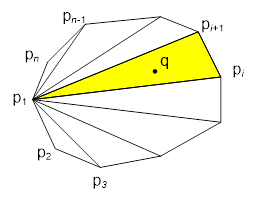
After the angle pip1pi+1 containing the point q is found, we can check in constant time
whether the points p1 and q lie on the same side of the line pipi+1. For this, the
orientation of the triple pipi+1q must be left (since the orientation of pipi+1p1 is left, as the polygon vertices are given in
counterclockwise order).
At the beginning of the algorithm, it is
also necessary to check boundary cases: if the orientation of the triple p1pnq is left or the
orientation of the triple p1p2q is right, then the point q lies outside the polygon.
Turn direction. Consider moving
from point А to point В, and then from В to point С. The turn is
considered left (counterclockwise) if the vector (pseudo-scalar)
product AB ´ BC > 0,
and
right if AB ´ BC < 0.
Algorithm implementation
Let us define a Point
structure and an array of points.
#define MAX 100001
struct Point
{
long long x, y;
Point(long long x = 0, long long y = 0) : x(x), y(y) {}
};
Point p[MAX];
The function angle determines whether
the turn made when moving through points А, B, С is left or right. To do this,
we calculate the corresponding vectors:
AB = (b.x – a.x, b.y – a.y)
BC = (c.x – b.x, c.y – b.y)
The pseudo-scalar (cross) product of AB ´ BC is
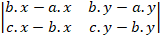 = (b.x – a.x)
* (c.y – b.y) – (b.y – a.y) * (c.x – b.x)
= (b.x – a.x)
* (c.y – b.y) – (b.y – a.y) * (c.x – b.x)
The sign of this expression determines the direction of the turn:
·
Positive
value – left turn;
·
Negative
value – right turn;
int angle(Point a, Point b, Point c)
{
long long q = (b.x - a.x) * (c.y - b.y) - (b.y - a.y) * (c.x - b.x);
return (q > 0) - (q < 0); // sgn(q)
}
The function inside returns true if the point q lies inside the
polygon.
bool inside(Point q)
{
We choose the first vertex of the polygon as the base.
Point a = p[1];
If the
orientation of the triple p1pnq is left, or the
orientation of the triple p1p2q is right, then the point q lies outside the
angle pnp1p2, and therefore outside the polygon.
if (angle(a, p[2], q) < 0 || angle(a, p[n], q) > 0) return false;
Perform a
binary search on the interval [l; r] = [2; n]. We look for points pl and pr (r = l + 1) such that the point q lies inside the angle plp1pr.
int l = 2, r = n, m;
while (l + 1 < r)
{
m =
(l + r) / 2;
if (angle(a, p[m], q) < 0)
r
= m;
else
l
= m;
}
return angle(p[l],
p[r], q) >= 0;
}
The main part of the program. Read the input data.
scanf("%d %d
%d", &n, &m, &k);
for (int i = 1; i <= n; i++)
{
scanf("%lld %lld", &x, &y);
p[i] = Point(x, y);
}
Compute the number of points that lie inside the polygon.
res = 0;
for (int i = 1; i <= m; ++i)
{
scanf("%lld %lld", &x, &y);
if (inside(Point(x, y))) res++;
}
Print the answer.
if (res < k) puts("NO"); else puts("YES");