2524. Fibonacci strings
In mathematics,
so-called recurrence relations are often used. They are usually employed to
define numerical sequences; however, they can also be used to define sequences
of strings.
One example of
strings defined by recurrence relations is the Fibonacci strings. They are
defined as follows:
F0 = a,
F1 = b,
Fi = Fi - 2 + Fi - 1, i > 1
The first seven Fibonacci
strings are:
a,
b,
ab,
bab,
abbab,
bababbab,
abbabbababbab
Dima attends an
olympiad programming club and is interested in string algorithms. Recently, he
learned about Fibonacci strings and quickly noticed that as the index i increases, the length of the string Fi grows very
rapidly. Therefore, storing the entire string requires too much memory. As a
result, Dima decided to restrict himself to the problem of finding individual
characters.
Write a program
that determines the k-th
character of the string Fn.
Input. The first line contains
the number of test cases t (1 ≤ t ≤ 100). Each of the next t lines contains two
integers n and k (0 ≤ n ≤ 45, 1 ≤ k ≤ |Fn|), where |Fn| denotes the length of the
string Fn. Character positions in
the string are numbered starting from one.
Output. Print
t
lines. Each line should contain exactly one character – the answer to the
corresponding test case.
|
Sample
input |
Sample
output |
40 11 13 2
7 7 |
a b a a |
SOLUTION
recursion
Algorithm
analysis
Fibonacci strings are
defined recursively:
Fn = Fn–2 + Fn–1
This means that the string Fn consists of two consecutive parts:
·
the first Fn–2
characters
form the string Fn–2,
·
the next Fn–1
characters
form the string Fn–1.
Therefore, to find the k-th character of the string Fn, it is not necessary to construct the
entire string. It is enough to determine in which of the two parts it lies.
Let Fn(k) denote the k-th character of the string Fn.

Then:
·
if k ≤ |Fn–2|, the required character lies in the
first part:
Fn(k) = Fn-2(k)
·
otherwise (if k > |Fn–2|), the character lies in the second part:
Fn(k) = Fn-1(k – |Fn–2|)
Thus, the problem reduces
to finding a character in strings with smaller indices.
Example
Consider
the string F6, for
which the following relations hold:
·
F6
= F4 + F5,
·
|F4| = 5, |F5| = 8
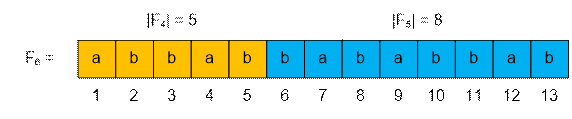
Let us compute F6(4). Since k = 4 ≤ |F4| = 5, we have F6(4)
= F4(4).
Let us compute F6(7). Since k = 7 > |F4| = 5, we have F6(7) = F5(7 – 5) = F5(2).
Algorithm implementation
The array fib
stores the lengths of the Fibonacci strings:
·
fib[i] contains the length of the
string Fi.
#define MAX 44
int fib[MAX] = {1, 1};
The function solve returns the k-th
character of the string Fn without
constructing the string itself in full.
char solve(int
n, int k)
{
The base cases n = 0 and n = 1 are handled
separately.
if (n == 0) return 'a';
if (n == 1) return 'b';
It is known that Fn
= Fn - 2 + Fn - 1.
·
If k ≤ Fn - 2, then the k-th character lies in the string Fn - 2.
·
If k > Fn - 2, then
the k-th character lies in the
string Fn - 1. However, its position is shifted by the
length of the first part, so we look for the character with index k – Fn - 2.
if (k <=
fib[n-2]) return solve(n - 2, k);
return
solve(n - 1, k - fib[n-2]);
}
The main part of the program. Compute
the first MAX Fibonacci numbers.
for (i = 2; i <
MAX; i++)
fib[i] = fib[i-1] + fib[i-2];
Read the number of test cases tests.
scanf("%d",&tests);
while (tests--)
{
Compute and print the answer for each test case.
scanf("%d
%d",&n,&k);
printf("%c\n",solve(n,k));
}