2590. Space
Exploration
Farmer John’s cows have
finally launched from Earth and are now drifting through space aboard their
Moocraft. They hope to reach their fellow cows on Io, one of Jupiter’s moons, but to
do so they must first pass through a dangerous asteroid belt.
Bessie is
piloting the ship through a sector of space of size n * n. The asteroids
in this sector are composed of 1 * 1 cells connected by their sides (cells that touch only at a
corner are considered part of different asteroids). Help Bessie by counting the
number of distinct asteroids in the entire sector.
Consider the 10 * 10 sector shown on
the left below. The characters “*” represent parts of asteroids, and each “.” denotes empty space. The right-hand
illustration shows an example numbering of the asteroids.
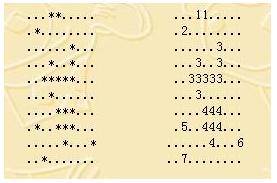
There are 7 asteroids in
this sector.
Input. The first line contains the integer n (1 ≤ n ≤
1000). Starting from the second line, the (i
+ 1)-th line contains the i-th row of
the asteroid field, consisting of n
characters.
Output. Print the number of asteroids in the field.
|
Sample
input |
Sample
output |
|
10 ...**..... .*........ ......*... ...*..*... ..*****... ...*...... ....***... .*..***... .....*...* ..*....... |
7 |
SOLUTION
depth first search
Algorithm analysis
Using depth first search, we
count the number of asteroids. This number matches the count of connected
components formed by the ‘*’ characters.
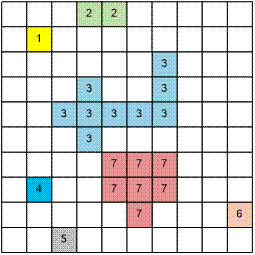
Example
The input field contains 7
asteroids.
Algorithm implementation
Declare a two-dimensional
character array (an array of strings) to store the field with asteroids.
string m[1001];
The dfs function performs a depth-first search on the grid,
starting from the cell (i, j).
void dfs(int
i, int j)
{
if ((i <
0) || (i >= n) || (j < 0) || (j >= n)) return;
if (m[i][j]
== '.') return;
m[i][j] = '.';
dfs(i-1,j); dfs(i+1,j);
dfs(i,j-1); dfs(i,j+1);
}
The main part of the
program. Read
the input data.
cin >> n;
for (i = 0; i < n; i++)
cin >>
m[i];
In the variable c we count the number of asteroids.
c = 0;
for (i = 0; i <
n; i++)
for (j = 0; j <
n; j++)
if (m[i][j]
== '*')
{
dfs(i,j);
c++;
}
Print the answer.
cout << c <<
endl;