4368. Triangular web
In front of you
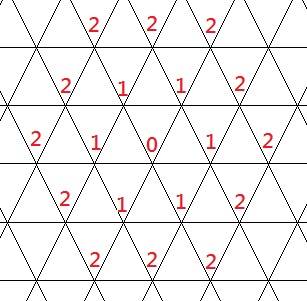
is an infinite triangular grid. It is arranged so that if a vertex is set on
fire, then at time 0 that vertex ignites, after one second all vertices directly adjacent to it
catch fire, then all vertices adjacent to the already burning ones, and so on.
Assume that the fire never goes out.
Initially, one
vertex is burning. Determine the number of burning vertices after n seconds.
Input. One integer n (0 ≤ n ≤ 109).
Output. Print the number of
burning vertices after n seconds.
|
Sample
input 1 |
Sample
output 1 |
|
1 |
7 |
|
|
|
|
Sample
input 2 |
Sample
output 2 |
|
1500 |
6754501 |
SOLUTION
combinatorics
Algorithm analysis
Let us consider how the
fire spreads on an infinite triangular grid:
1.
Initial vertex. At time  , only the initial vertex
is burning. This contributes the first unit to the total number of burning
vertices.
, only the initial vertex
is burning. This contributes the first unit to the total number of burning
vertices.
2.
First level (after 1 second). The vertices that are
directly adjacent to the initial one catch fire after 1 second. In a triangular
grid, each vertex has 6 neighbors. Therefore, the first level contains 6
vertices.
3.
Second level (after 2 seconds). In the next second, the
vertices that are adjacent to the already burning vertices of the first level,
but are not yet burning, catch fire. The second level contains 12 vertices.
One can observe the
following pattern: each new level adds 6 more vertices than the previous one.
·
First level: 6 vertices
·
Second level: 12 vertices
·
Third level: 18 vertices
·
… and so on.
Thus, we obtain an
arithmetic progression with the first term a1 = 6 and common difference d = 6.
After n seconds, the number of
burning vertices is equal to
res = 1 + (6 + 12 + 18 + … + (6 + 6(n – 1)))
Using the formula for the
sum of an arithmetic progression  , we obtain that
res = 1 +  = 1 + (6 + 3(n – 1))n = 1 + 3n(n
+ 1)
= 1 + (6 + 3(n – 1))n = 1 + 3n(n
+ 1)
Algorithm implementation
Read the input value of n.
scanf("%lld",&n);
Compute and print the answer.
res = 1 + 3 * n * (n + 1);
printf("%lld\n",res);