4469. Domino
Find the number
of ways to completely tile a rectangle of size 2 × n with dominoes of size 2 × 1.
Coverings that coincide with themselves under symmetries (rotations or
reflections) are considered different.
Input. One integer n (0 < n <
65536).
Output. Print the
number of ways to tile the rectangle with dominoes.

|
Sample
input 1 |
Sample
output 1 |
|
1 |
1 |
|
|
|
|
Sample
input 2 |
Sample
output 2 |
|
4 |
5 |
SOLUTION
Fibonacci numbers
Algorithm analysis
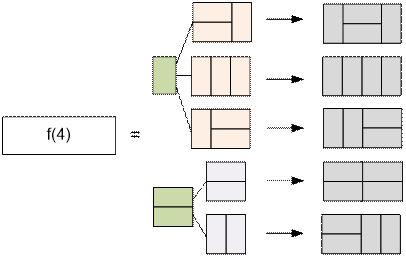
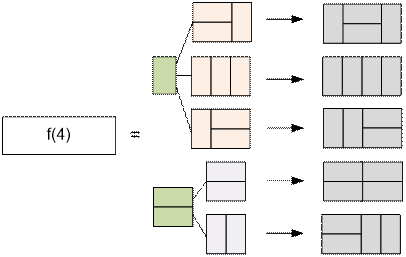
Let f(n) denote the number of ways
to tile a 2 × n rectangle with 2 × 1
dominoes. It is
clear that
·
f(1) = 1, one vertical domino;
·
f(2) = 2, either two vertical dominoes or two horizontal dominoes.

Consider the algorithm for
computing f(n):
·
we can place one domino vertically, after which the remaining
rectangle of length n – 1 can be tiled in f(n – 1) ways,
·
or we can place two dominoes horizontally, after which the
remaining rectangle of length n – 2 can be tiled in f(n – 2) ways.
Thus, we obtain the
recurrence relation:
f(n) = f(n
– 1) + f(n – 2)
Therefore, f(n)
is a
Fibonacci number.
Algorithm implementation
Since n < 65536, long arithmetic or Java programming language should
be used.
import java.util.*;
import java.math.*;
public class Main
{
public static void main(String[] args)
{
Scanner con = new Scanner(System.in);
int n = con.nextInt();
BigInteger a = new BigInteger("1"), b = a;
for(int i = 0; i < n; i++)
{
BigInteger temp = a.add(b);
a = b;
b = temp;
}
System.out.println(a);
con.close();
}
}
Python implementation
Increase
the limit to the required value (for example, 100,000 digits).
import sys
sys.set_int_max_str_digits(100000)
Read the
input value n.
n = int(input())
Process the
base cases.
if n == 1:
print(1)
elif n == 2:
print(2)
else:
Compute the n-th
Fibonacci number.
f1, f2 = 1, 2
for i in range(n - 2):
temp = f1 + f2
f1, f2 = f2, temp
Print the
answer.
print(f2)