5198. Modular Exponentiation
Find the value of
the expression xn mod m.
Input. Three positive integers x, n, m (1 ≤ x, n ≤ 109, 2 ≤ m ≤ 109).
Output. Print the value of xn mod m.
|
Sample
input |
Sample
output |
|
2 3 100 |
8 |
SOLUTION
recursion
Algorithm
analysis
To find the value of xn mod m use the formula:
xn mod m =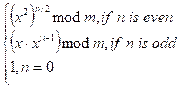
Let’s consider the iterative
exponentiation algorithm.
Any integer n can be represented in binary form:
n = bk 2k
+ … + b1 21 + b0 20
For example:
13 = 11012 = 8
+ 4 + 1
Using this representation,
the power x13 can be rewritten as a product of powers of two:
x13 = x8 ∙
x4 ∙ x1
To compute the power, it
is necessary to multiply only those powers for which the corresponding bit in
the binary representation is 1.
To construct any power xn, it is sufficient to have only powers
of the form:
x1, x2,
x4, x8, x16, …
The algorithm for
computing xn scans the bits of the
number n from the least significant to the most significant, and at
each iteration:
·
If the current bit of the number n is 1, multiply the result res by the current power x;
·
Square the base x;
·
Shift the exponent n one bit to the right
(divide n by 2).
13 = 11012
|
n |
bit |
degree x |
res |
|
13 |
1 |
x1 |
x1 |
|
6 |
0 |
x2 |
x1 |
|
3 |
1 |
x4 |
x5 |
|
1 |
1 |
x8 |
x13 |
Algorithm implementation
– recursion
The
powmod function computes the value of xn mod m.
long long
powmod(long long x, long long n, long long m)
{
if (n
== 0) return 1;
if (n %
2 == 0) return powmod((x * x) % m, n / 2, m);
return (x *
powmod(x, n - 1, m)) % m;
}
The main part of the program. Read the input data.
scanf("%lld %lld %lld",
&x, &n, &m);
Compute the value of xn mod m.
res = powmod(x, n, m);
Print the answer.
printf("%lld\n",
res);
Algorithm implementation
– iteration
The
powmod function computes the value of xn mod m.
long long powmod(long long x, long long n, long long m)
{
long long res = 1;
while (n > 0)
{
if (n & 1) res = (res * x) % m;
x = (x * x) % m;
n >>= 1;
}
return res;
}
The main part of the program. Read the input data.
scanf("%lld %lld %lld",
&x, &n, &m);
Compute the value of xn mod m.
res = powmod(x, n, m);
Print the answer.
printf("%lld\n",
res);
Java implementation
import java.util.*;
public class Main
{
static long PowMod(long x, long n, long m)
{
if (n == 0) return 1;
if (n % 2 == 0) return PowMod((x * x) % m, n / 2, m);
return (x * PowMod(x, n - 1, m)) % m;
}
public static void main(String[] args)
{
Scanner con = new
Scanner(System.in);
long x = con.nextLong();
long n = con.nextLong();
long m = con.nextLong();
long res = PowMod(x, n, m);
System.out.println(res);
con.close();
}
}
Java implementation –
BigInteger
import java.util.*;
import java.math.*;
public class Main
{
public static void main(String[] args)
{
Scanner con = new
Scanner(System.in);
BigInteger a = con.nextBigInteger();
BigInteger b = con.nextBigInteger();
BigInteger m = con.nextBigInteger();
System.out.println(a.modPow(b, m));
con.close();
}
}
Python implementation –
pow
Read the input data.
x,
n, m = map(int, input().split())
Compute and print the answer.
print(pow(x,
n, m))
Python implementation –
recursion
The
myPow function computes the value of xn mod m.
def myPow(x, n, m):
if (n == 0): return 1
if (n % 2 == 0): return myPow((x * x) % m, n / 2, m)
return (x * myPow(x, n - 1,
m)) % m
The main part of the program. Read the input data.
x,
n, m = map(int, input().split())
Compute and print the answer.
print(myPow(x, n, m))