5283. Thaw
Tired of the unusually warm winter, the
residents of Frostholm decided to determine whether the current thaw is indeed
the longest in the entire history of meteorological observations. They turned
to meteorologists, who in turn began analyzing statistical data from previous
years. They are interested in how many days the longest thaw lasted.
A thaw is defined as a period during which
the average daily temperature exceeded 0 degrees Celsius every day. Write a
program that will help the meteorologists solve this problem.
Input. The first line contains the number of days n (1 ≤ n ≤ 1000) under consideration.
The second line contains n integers – the average daily temperatures for the
corresponding days. The temperatures are integers in the range from -50 to 50.
Output. Print
one integer – the length of the longest thaw, that is, the maximum number of
consecutive days during which the average daily temperature exceeded 0 degrees.
If the temperature was non-positive on all days, print 0.
|
Sample
input |
Sample
output |
|
6 -20 30 0 50 10 -10 |
2 |
SOLUTION
arrays
Algorithm analysis
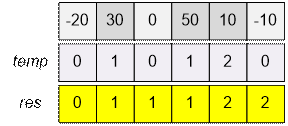
The variable res stores the length of the longest
thaw.
The variable temp stores the length of the current
thaw – that is, the number of consecutive
days with a positive temperature.
For each
day, the temperature value is analyzed:
·
if the
temperature is positive, the value of temp is increased by 1;
·
otherwise,
temp is reset to 0.
During the
processing of all days, the maximum among the values of temp is
maintained and stored in the variable res.
Example
Let us consider an
example.
Algorithm implementation
Read
the number of days n.
scanf("%d", &n);
The variable res stores the length of the longest thaw.
The variable temp stores the length of the current thaw (the number
of consecutive days with a positive temperature).
temp = res = 0;
Process the temperatures for all n days.
for (i = 0; i < n; i++)
{
scanf("%d", &cur);
If cur > 0, increase the length of the current
thaw by 1. Otherwise,
reset its value to 0.
if (cur > 0) temp++; else temp = 0;
Among all obtained values of the current thaw length, we
maintain the maximum value.
if (temp > res) res = temp;
}
Print the answer.
printf("%d\n", res);