5716. Card houses
Slavik dreams of
becoming a performer of an original genre, so he constantly practices
manipulating various objects. Lately, he has been dedicating all his free time
to building card houses. He has already managed to construct a four-story card
house at home, which required 26 cards. During a technology class, Slavik
secretly demonstrated his skill to his classmates by building a three-story
card house using only 15 cards.
The “creations” of
the future artist are captured in the photos below:

Now Slavik is
interested in a mathematical question: how many cards are needed to build a
card house of stories?
He asks for your
help, as mathematics is not his strongest subject.
Input. One non-negative
integer n (n
≤ 108) – the number of stories in the card house to be
built.
Output. Print the number of cards required to build a card
house with n stories.
|
Sample
input |
Sample
output |
|
3 |
15 |
SOLUTION
combinatorics
Algorithm analysis
Let f(h) denote the number of cards required to build a card house of
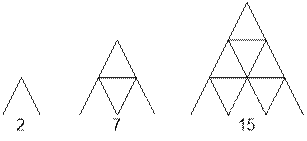
height  . For example, f(1) = 2, f(2) = 7, and f(3) = 15.
To build a house of height
h, one must place h houses of height 1 at the base, which requires 2h cards, as well as h
– 1 horizontal cards forming the overlaps. On top of this base, a house of
height h – 1 is placed, which
requires f(h – 1) cards.
Therefore,
f(h) = 2h + h – 1 + f(h – 1)
or equivalently,
f(h) = 3h – 1 + f(h – 1)
Let us derive an explicit
formula. By successively expanding the recursion, we obtain:
f(h) = 3h – 1 + f(h – 1) =
= 3h – 1 + 3(h – 1) – 1 + f(h – 2) =
. . .
= 3h – 1 + 3(h – 1) – 1 + 3(h – 2) – 1 + … + 3 * 1 – 1 =
= 3 (h + (h – 1) + (h – 2) + … + 1) – h =
=  =
=  =
= 
Example
A house of height 1 requires 2 cards.
A house of height 2 requires 7 cards.
A house of height 3 can be built using 15
cards.
Algorithm implementation
Read the
height of the house n.
scanf("%lld", &n);
Compute and print
the number of cards required to build the house.
res = n * (3 * n + 1) / 2;
printf("%lld\n", res);