5730. YAPTCHA
The Faculty of
Mathematics encountered a problem. Due to the large number of automated
programs browsing their web pages, it was decided to restrict access to their
scientific articles.
To gain access,
one must now demonstrate their knowledge – namely, solve a mathematical
problem.
However, the test
turned out to be too difficult not only for graduate students, but even for
some professors. Therefore, the faculty needs to develop a program that
automatically solves this problem.
Visitors to the
main page of the Faculty of Mathematics are given the following task: for a
given positive integer n, compute the value
Sn
= 
where ⌊x⌋ denotes the
greatest integer less than or equal to x.
Input. The first line
contains the number of queries t
(t ≤ 106).
Each of the
following t lines
contains one integer n (1
≤ n ≤ 106).
Output. For each query, print the value of Sn on a
separate line.
|
Sample
input |
Sample
output |
|
13 1 2 3 4 5 6 7 8 9 10 100 1000 10000 |
0 1 1 2 2 2 2 3 3 4 28 207 1609 |
SOLUTION
sieve of Eratosthenes
Algorithm analysis
Let m = 3k + 7. Then the given expression can be
rewritten in the form:
Sn
= 
Wilson’s Theorem. If m is a prime
number, then
(m – 1)! = -1 (mod m)
That is,
(m – 1)! + 1 = 0 (mod m)
Therefore, if m is
prime, the number  is an integer.
At the same time,
 =
= 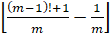 = – 1
= – 1
Then the entire expression
equals
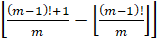 = –
= – 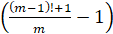 = 1
= 1
If m is a composite
number, then
(m – 1)! = 0 (mod m),
because among its factors
there are all the divisors of m.
In this case, the number

is an integer.
Then the entire expression
equals
= 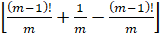 =
=  = 0
= 0
Therefore, to compute Sn, it is enough to count the
number of prime numbers of the form 3k + 7 for 1 ≤ k ≤
n.
Using the
Sieve of Eratosthenes, we build the array used, where:

Then, using
the array used, construct the array a, which stores information about prime numbers of the
form 3i + 7:

Now
Sn = a[1] + a[2] + … + a[n]
Since the problem contains
many test cases, to answer each in constant time, we build the prefix sums:
p[i] = a[1] + a[2] + … + a[i]
Now, to solve the problem
for any given value of  , it is enough to print p[n].
Example
Let m = 7 be a prime number. Then
 =
=  =
= 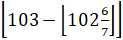 =
=  = 1
= 1
Let m = 6 be a composite number.
Then
 =
=  =
= 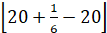 =
=  = 0
= 0
Let’s compute the answer for n = 10. Consider all numbers of the
form 3k + 7, where 1 ≤ k
≤ 10. Among them, identify the
prime numbers.

Among the listed numbers, there are 4 prime
numbers: 13, 19, 31 and 37. Therefore, S10 = 4.
Algorithm implementation
Let us declare the arrays. Since n
≤ 106, the size of the arrays should be set to 3n +
7 = 3 * 106 + 7.
#define MAX 3000010
char used[MAX], a[MAX];
The
function Init implements the Sieve of Eratosthenes. The array used
stores information about prime numbers:
The array a
stores information about prime numbers of the form 3i + 7:
void Init()
{
for (int i = 2; i < MAX; i++)
{
if (!used[i])
{
if ((i - 7) % 3 == 0)
a[(i - 7) / 3] = true;
if (i < sqrt(MAX))
for (int j = i * i; j < MAX; j += i)
used[j] = true;
}
}
}
The main
part of the program. Fill the arrays.
Init();
Compute the
prefix sums for the array a:
p[i] = a1 + a2
+ … + ai
for (int i = 2; i < MAX; ++i)
p[i] = p[i - 1] + a[i];
Process the
tests sequentially.
scanf("%d", &tests);
while (tests--)
{
scanf("%d", &n);
For each
value of n print p[n].
printf("%d\n", p[n]);
}