7438. Binary password
Jomart uses a
binary string as the password for his computer. Recently, he forgot his old
password and now wants to obtain a new one, which will be a binary string of
length n. He considers a password
sufficiently secure if it does not contain two consecutive zeros.
To obtain a new
password, Jomart generates a random binary string of length n. If the string is not secure, he
generates another one and repeats the process until he obtains a secure
password.
Find the expected
number of randomly generated passwords Jomart will need before he finds a
secure one.
Input. One integer n (1
≤ n ≤ 60).
Output. Print the expected value as a fraction p / q, where p and q are coprime positive
integers.
|
Sample
input 1 |
Sample
output 1 |
|
1 |
1/1 |
|
|
|
|
Sample
input 2 |
Sample
output 2 |
|
4 |
2/1 |
SOLUTION
mathematics
Algorithm analysis
A password (a
string of length n) is considered secure if it does not contain two
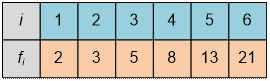
consecutive zeros. The number of such strings is equal to the Fibonacci number fn, defined as
follows:
f1 = 2 (the strings 0, 1),
f2 = 3 (the strings 01,
10, 11),
fn = fn-1 + fn-2, n > 3
For example, the
first Fibonacci numbers are:
The total number
of binary strings of length n is 2n. Therefore, the expected number of randomly
generated strings required to obtain a secure one is equal to
2n / fn
This fraction
should be reduced by dividing the numerator and the denominator by their
greatest common divisor.
Example
For n = 1, the answer is 21 / f1 = 2 / 2 = 1 / 1.
For n = 4, the answer is 24 / f4 = 16 /
8 = 2 / 1.
Algorithm implementation
Declare an array to store the Fibonacci numbers.
long long f[61];
The function gcd computes the greatest common divisor of two numbers.
long long gcd(long long a, long long b)
{
return (!b) ? a : gcd(b, a % b);
}
The main part of the program. Read the input value n.
scanf("%d", &n);
Compute the Fibonacci numbers.
f[0] = 1; f[1] = 2;
for (i = 2; i <= n; i++)
f[i] = f[i - 1] + f[i - 2];
The answer is given as a fraction:
num / den = 2n / fn
Reduce this fraction by dividing the numerator and the denominator by
their greatest common divisor.
num = (1LL << n);
den = f[n];
d = gcd(num, den);
num /= d;
den /= d;
Print the answer.
printf("%lld/%lld\n", num,
den);