7747. City Horizon
Farmer John has arrived in the city with his cows!
During sunset, the cows look at the city skyline and observe beautiful
silhouettes formed by rectangular buildings.
The entire skyline is represented by a number line
with n buildings. The silhouette of the i-th
building extends along the horizon between points ai and bi and has height hi. Determine the total area (in square units) of the
silhouette formed by all n buildings.
Input. The first line contains an integer n
(1
≤ n ≤ 40000). Each of the next n lines describes the i-th building with three
integers: ai, bi (1
≤ ai < bi ≤ 109) and hi (1 ≤ hi ≤ 109).
Output. Print the total area of the city skyline (in square units) formed by
all n buildings.
|
Sample
input |
Sample
output |
|
4 2
5 1 9
10 4 6
8 2 4
6 3 |
16 |
SOLUTION
sweeping line
Algorithm analysis
Consider
all points – the x-coordinates of the beginnings and ends of the
buildings – and sort them in increasing order. For each such point, we store:
·
its coordinate,
·
its type (start of a building – type = 0, end – type
= 1),
·
the height of the corresponding building.
Next,
process these points sequentially from left to right.
We
maintain a multiset s that stores the heights of buildings that have
already started but have not yet ended at the current moment. This multiset
allows us to efficiently determine the maximum height among the active
buildings.
Let the
current point have coordinate xi, and the
next point xi+1. Let h denote the maximum element in the
multiset s (if the set is empty, assume h = 0). Then, on
the interval [xi, xi+1]), the maximum height of the silhouette is h, and the
contribution to the area is
(xi+1 – xi) * h
Add this value to the total area.
After
that, update the multiset:
·
if the point xi is the start of a building, insert
its height into s;
·
if it is the end of a building, we remove the
corresponding height from s.
The order
of processing events with the same x-coordinate (starts and ends of
buildings) does not affect the correctness of the solution, since segments of
zero length do not contribute to the area.
Example
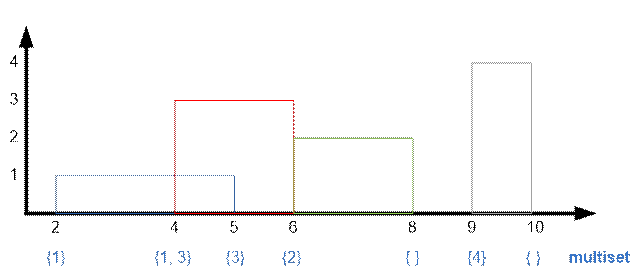
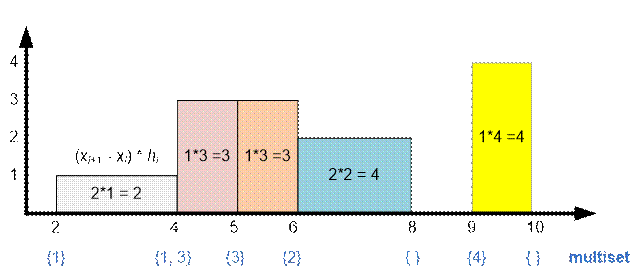
Algorithm implementation
To represent a point, we introduce a structure node
that stores its x-coordinate, a flag indicating whether it is the start
(type = 0) or the end (type = 1) of a segment, and the height h
of the corresponding building.
struct node
{
int x, type, h;
node(int x, int type, int h) : x(x), type(type), h(h) {};
};
Define a comparator f for points – sort them
in increasing order of their x-coordinates.
int f(node a, node b)
{
return a.x < b.x;
}
Declare an array of points Event, as well as a
multiset s to store the heights of buildings intersecting the current
position of the sweep line.
vector<node> Event;
multiset<int, greater<int> > s;
Read the input data. Construct the array of points.
scanf("%d",&n);
for(i = 0; i < n; i++)
{
scanf("%d %d %d",&left,&right,&height);
Event.push_back(node(left,0,height));
Event.push_back(node(right,1,height));
}
Sort the array of points in non-decreasing order of
their x-coordinates.
sort(Event.begin(),Event.end(),f);
Accumulate
the total area of the city skyline in the variable res.
res
= 0;
Move from
left to right over the points in the Event array. For each index i
in the for loop,
consider the interval (Event[i].x,
Event[i + 1].x).
for (i = 0; i < Event.size() - 1; i++)
{
If the point xi is the start of a building,
insert the corresponding height into the multiset.
int h = Event[i].h;
if (Event[i].type == 0) s.insert(h);
If the point xi is the end of a building, remove
the corresponding height from the multiset.
else s.erase(s.find(h));
If the multiset is not empty, then on the segment
between Event[i].x and Event[i + 1].x there exists a skyline whose height is equal to the maximum
element in s, i.e. *s.begin().
if (!s.empty())
res += 1LL * *s.begin() * (Event[i+1].x - Event[i].x);
}
Print the
computed area.
printf("%lld\n",res);
Algorithm implementation – segment tree
Perform
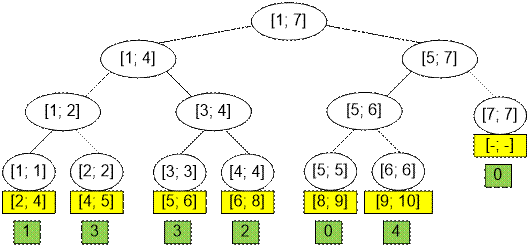
coordinate compression of the buildings’ x-coordinates using a mapping mp (for example, mp[2] = 1, mp[4] = 2 and
so on). Then build a segment tree over the range [1..len], where len ≤ 40000.
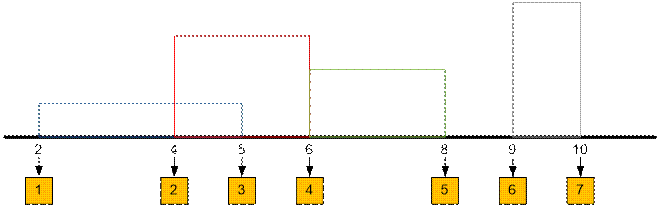
Each leaf of the segment tree corresponds to a single
elementary (indivisible) interval of the skyline on the horizon. For example,
node 1 corresponds to the interval [2; 4], and node 2 corresponds to [4; 5].
Then, a segment [a, b] is covered by the segment tree nodes with
indices [mp[a], mp[b] – 1]. For example, the segment [2; 5] is
covered by the nodes [mp[2], mp[5] – 1] = [1, 2].
For
each building on the interval [ai,
bi] with height hi, increase the values in the segment tree over the interval
[mp[ai], mp[bi] – 1]. While propagating values in the
tree nodes, we maintain the maximum:
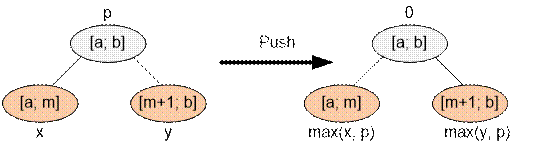
Push all
values from the internal nodes down to the leaves, after which the leaves will
store the heights of the skyline on the corresponding intervals. For example,
the first leaf corresponds to the interval [2; 4] and contains the value 1, the
second leaf corresponds to [4; 5] and contains the value 3, and so on. The last
node of the segment tree does not correspond to any interval and is considered
a dummy node.
#include <cstdio>
#include <cstring>
#include <set>
#include <map>
#include <vector>
#include <algorithm>
#define MAX 80010
using namespace std;
int SegTree[4*MAX];
vector<int>
a;
map<int,int> mp;
int i,
n, l, r, h, len;
long long res;
struct Building
{
int left, right, height;
} b[40010];
void
Push(int Vertex, int
LeftPos, int Middle, int RightPos)
{
if (SegTree[Vertex])
{
SegTree[2*Vertex] = max(SegTree[2*Vertex],SegTree[Vertex]);
SegTree[2*Vertex+1] = max(SegTree[2*Vertex+1],SegTree[Vertex]);
SegTree[Vertex] = 0;
}
}
void
Add(int Vertex, int
LeftPos, int RightPos,
int Left, int
Right, int x)
{
if (Left > Right) return;
if ((LeftPos == Left)
&& (RightPos == Right))
SegTree[Vertex] = max(SegTree[Vertex],x);
else
{
int Middle = (LeftPos
+ RightPos) / 2;
Push(Vertex,LeftPos,Middle,RightPos);
Add(2*Vertex, LeftPos, Middle, Left, min(Middle,Right), x);
Add(2*Vertex+1, Middle+1, RightPos,
max(Left,Middle+1), Right, x);
}
}
long long Count(int Vertex, int LeftPos, int RightPos)
{
if (LeftPos == RightPos)
return 1LL * SegTree[Vertex]
* (a[LeftPos+1] - a[LeftPos]);
else
{
int Middle = (LeftPos
+ RightPos) / 2;
Push(Vertex,LeftPos,Middle,RightPos);
return Count(2*Vertex, LeftPos, Middle) +
Count(2*Vertex+1, Middle+1, RightPos);
}
}
int
main(void)
{
scanf("%d",&n);
memset(SegTree,0,sizeof(SegTree));
set<int> s;
for(i = 1; i <= n; i++)
{
scanf("%d %d %d",&b[i].left,&b[i].right,&b[i].height);
s.insert(b[i].left); s.insert(b[i].right);
}
len = s.size(); a.resize(len+2);
copy(s.begin(),s.end(),a.begin()+1);
for(i = 1; i <= len; i++) mp[a[i]]
= i;
for(i = 1; i <= n; i++)
Add(1,1,len,mp[b[i].left],mp[b[i].right]-1,b[i].height);
res = Count(1,1,len);
printf("%lld\n",res);
return 0;
}